
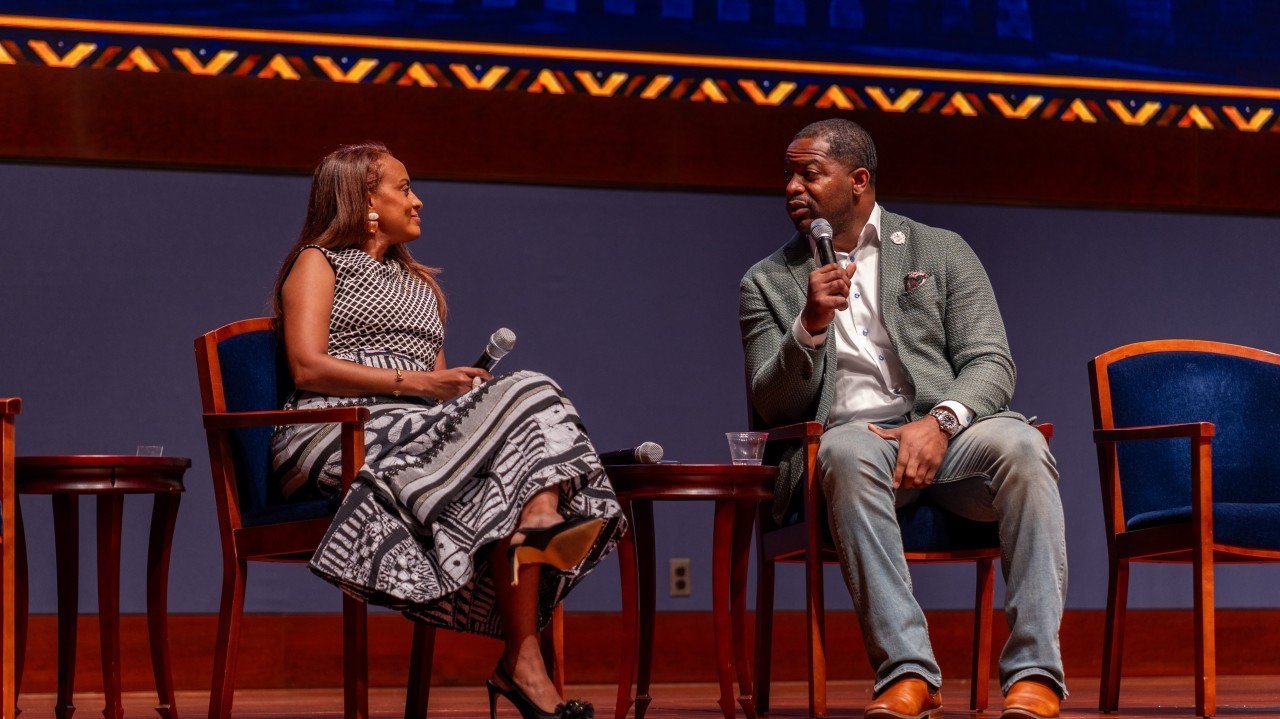
Cover photo: With Sam Barrington at African Diaspora Day on the Hill, U.S. Capitol Visitor Center, September 16, 2026. Photo: Zay Cruise Media
Over the last two months, I have found myself in multiple conversations around the notion of diaspora capital and how to unlock it, from a fireside chat at the U.S. Capitol in September to calls with funders this fall. It is a timely question, a question we have been advocating for years, if not decades, but it is worth examining with a new lens. When we think of unlocking diaspora capital, everyone’s inclination is to focus on the finances and on the remittances, but let’s remember what diaspora capital really is.
Remittances are the tip of the iceberg. Imagine what becomes possible when institutions tap into the power of diasporas beyond remittances: their expertise, their ability to move between places, and their transfer of skills and knowledge.
Diaspora Capital Is Time, Talent, and Treasure
At The Diaspora Academy, we define diaspora capital through our 3Ts, and all three are already moving:
✅ Time: The strategic allocation of attention and hours toward public outcomes: policy advocacy, participation in governance, and consistent follow-through. According to the GivingTuesday Data Commons, 11.1 million people in the United States volunteered on GivingTuesday 2025, and diaspora communities sit inside that number.
✅ Talent: The structured transfer of professional expertise in ways that fit local realities and strengthen institutions on both sides. A single diaspora professional often holds relationships across universities, associations, and hometown networks that would take an institution years to build.
✅ Treasure: The shift from ad hoc generosity to structured investment that supports sustainable programs and credible accountability. Remittances are the most visible channel, an estimated $905 billion worldwide in 2024 according to the IOM World Migration Report 2026, alongside diaspora bonds, funds, philanthropy, and direct investment.
Diasporas Must Invest In Themselves Before The Homeland
In September, I moderated a fireside chat with Sam Barrington, MBA at African Diaspora Day on the Hill, hosted by Black Professionals in International Affairs – BPIA, Most Influential People of African Descent (MIPAD), and the Congressional Black Associates at the U.S. Capitol Visitor Center. Sam played linebacker for the Green Bay Packers, leads Sky Limit Crane & Rigging as president and CEO, with deep family ties to Ghana.
I have said that our job in the diaspora is to discover all that we are so we can give more, and to invest in ourselves early so we can give back to ourselves and back home.
Sam is living proof of this point. His transition from athlete to entrepreneur taught him lessons every diaspora professional can use: invest first in the capital you already possess, in your mind, in your talents, and then in your finances. Rewriting who he was in this next chapter, he went back to school to get his MBA. He tested and pushed himself. He dove into business before committing to Ghana. Which is exactly what he meant when he said, “Cash flow is not equity.” Readiness is. Readiness before return.
It’s clear that diaspora capital takes more than one form. It looks like philanthropy: humanitarian relief in an emergency, donations to a school or a clinic, and in-kind support that never appears on a balance sheet. It looks like investment: diaspora bonds, equity in a founder’s first company, and the economic opportunities that follow when a diaspora professional opens a market. And it looks like networks: access, knowledge and expertise, language ability, influence, reach, and the insights that only someone who moves between two worlds can offer.
Diasporas balance these three capitals quite often and quite regularly, sometimes in the same week.
As we approach the end of the year, I want you to think about how you can use your own capital to support diasporas, and how you can invite their time, talent, and treasure in return:
- What pathways are you willing to unlock, open, or offer?
- What partnerships are you willing to define and build?
- What programs are you willing to bring diasporas into?
- What seed money and funding are you willing to put behind diaspora capital?
Three Ways to Unlock Diaspora Capital This Giving Season
As we near the end of 2026, let’s prepare ourselves for what we’re willing to put in to unlock that diaspora capital. According to the GivingTuesday Data Commons, people in the United States gave $4.0 billion on GivingTuesday 2025. The question now is whether we are prepared to support diasporas as part of the next Giving Tuesday and if governments, organizations, and companies will meet this season with a focus on direct support and partnership with immigrant and diaspora-focused organizations.
Here are three recommendations for how to give back, how to invest, and how to put every form of capital diasporas possess to work.
- First, give back with time and talent in proportion to treasure. A board seat, a mentorship, or an introduction often outlasts any single gift.
- Secondly, invest in readiness before return. Build a runway before a spotlight: pair new diaspora investors and donors with operators who share deal flow and honest feedback, and hold the big ask until the relationship is ready.
- Lastly, put every form of capital to work all year. Invite diaspora professionals to the planning table, the product launch, and the investor briefing in March, so they are ready to say yes in December. Diasporas need time to explore and decide, and the institutions that give them that time earn the commitment.
Above all else, partnership is everything. Diasporas invest time, talent, and treasure, and every one of those investments deserves a partnership built to match it.
👉🏾 Start with the basics. Download An Introduction to Diasporas, a brief primer on who diasporas are and how they stay connected.
👉🏾 Subscribe to Diaspora Digest
One email every Monday, with news, data, builders, events, and jobs from across the diaspora world.
