
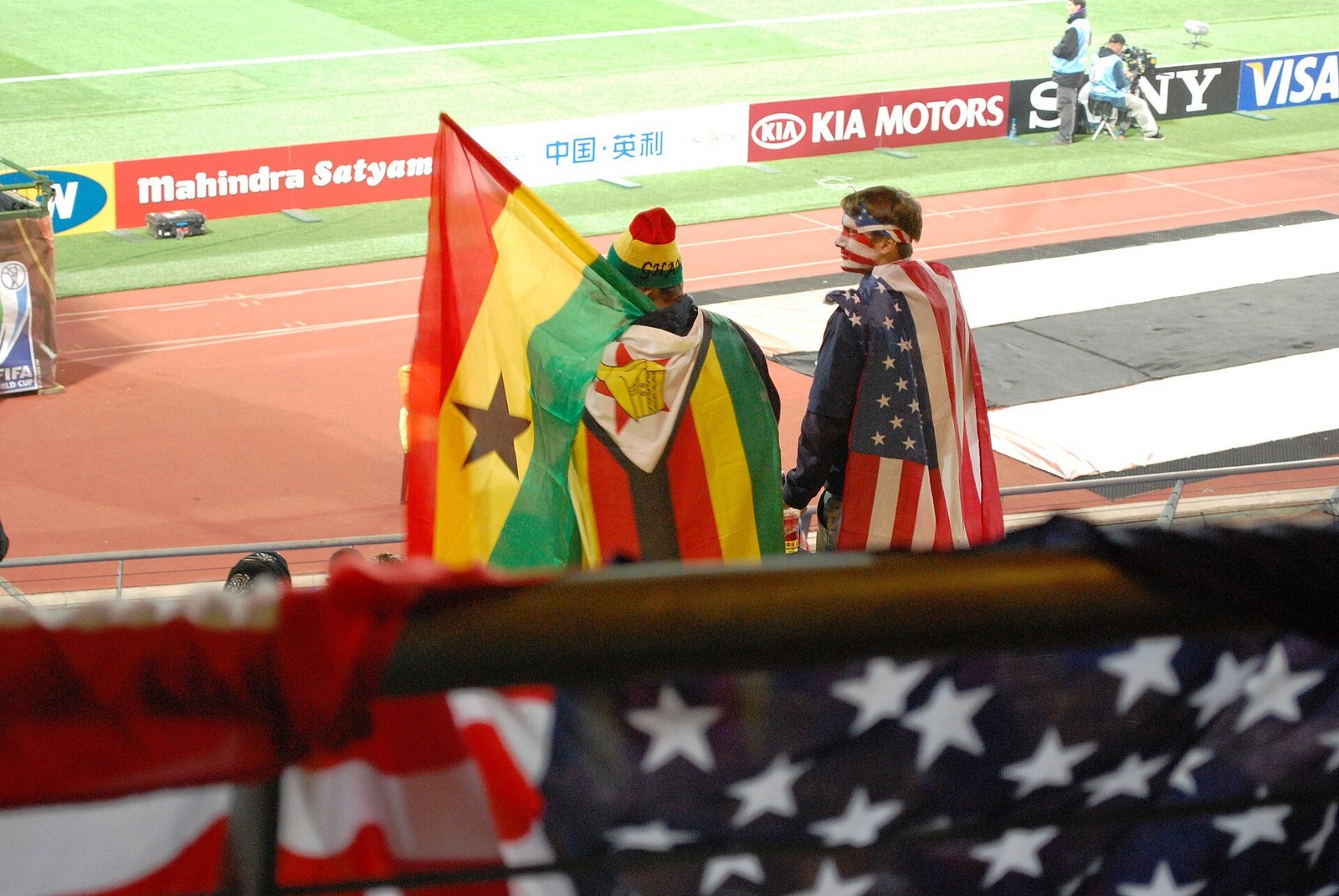
Cover photo: Ghanaian and American fans at the 2010 World Cup match between the United States and Ghana. Credit: U.S. Department of State (public domain).
What does it mean to build something in two places at once?
Diaspora communities have been answering that question for generations, long before any institution decided to study it. The 2026 FIFA World Cup, live across the United States, Canada, and Mexico, is making the answer visible to 54 million viewers in the host nations alone. Recent coverage reflects a growing recognition of the diaspora as a sports audience, but what can we learn about their role and relationship with ancestral and adopted homelands?
The Welcome Starts Before the Whistle
When Ghana’s Black Stars touched down in the United States for the tournament, hundreds of fans gathered at the terminal waving flags, singing traditional melodies, and displaying vibrant kente cloth. That welcome was organized, coordinated, and intentional, reflecting the kind of investment diaspora communities extend toward home long before anyone asks them to.
The Ghana Diaspora Public Affairs Collective (GHPAC), a nonpartisan advocacy collective based in Washington, D.C., hosted a Global Pitch World Cup Watch Party in May, bringing together supporters, professionals, creatives, and community members for a celebration centered on soccer, culture, and global Ghanaian engagement. They move from policy advocacy and civic engagement to celebrating sports and culture, because for diaspora communities, the two have always occupied the same organizing space.
The Rosters Are the Data
Of the nearly 1250 players in the World Cup, roughly 23 percent qualified for their team through through ancestry or naturalization, making the 2026 World Cup the most diasporic in the history of the sport. Just twenty years ago, at the 2006 World Cup, that figure was less than 9%.
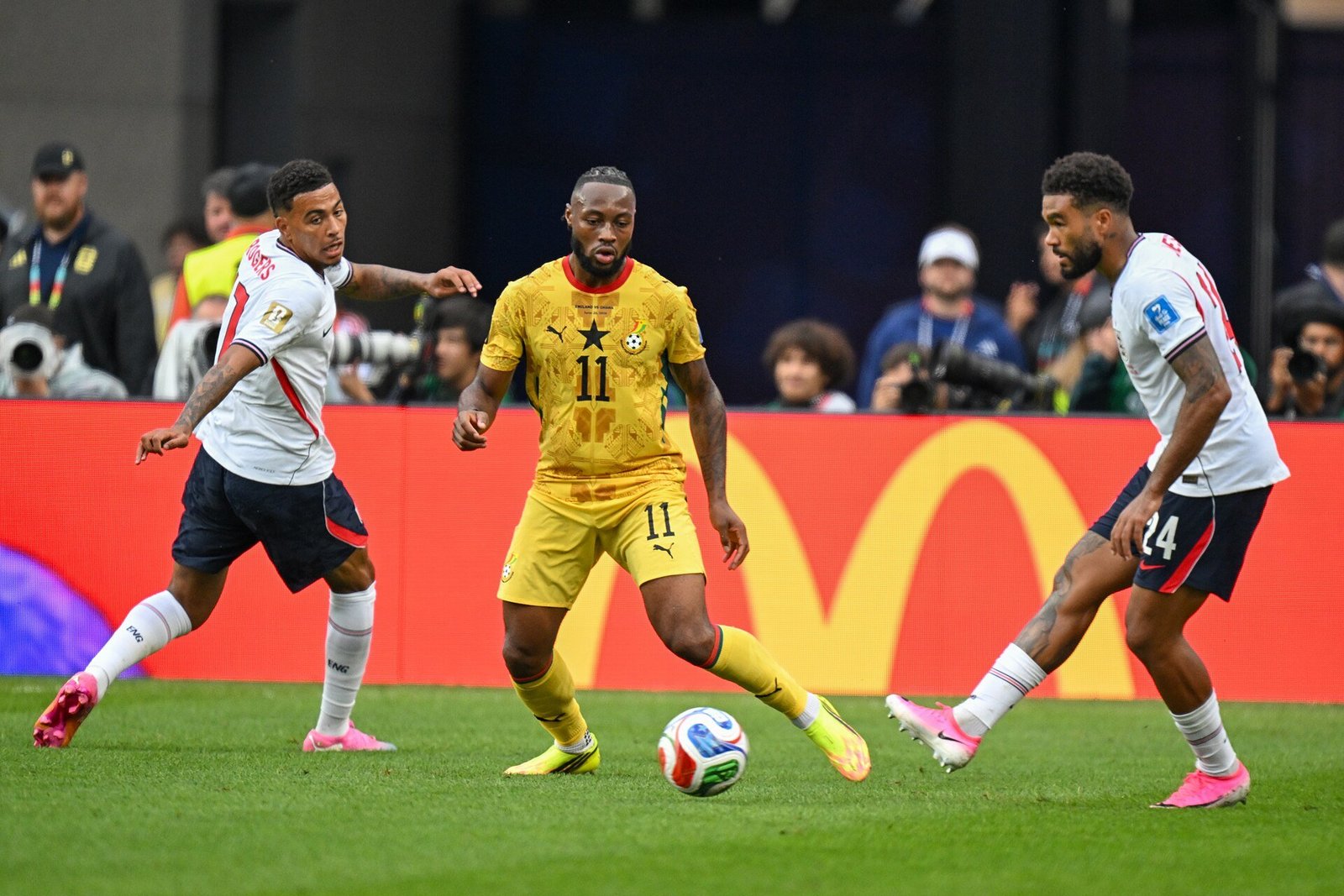
Ghana’s eight foreign-born players place them among the most globally assembled rosters in the tournament, alongside Croatia, Australia, and New Zealand. The Ghana Football Association’s UK Talent Hunt program, launched in London in May 2026, signals that this recruitment has become systematic, identifying players before their loyalties fully form and building pathways before European nations arrive first.
The Decisions Players Make Are the Decisions Diaspora Makes
Every eligibility choice at this tournament mirrors the negotiation that millions of diaspora professionals work through every week, in boardrooms, inside community organizations, at family dinners, and in the private moments when they weigh where they belong and where they want to build.
For example, Folarin Balogun, born in Brooklyn to Nigerian parents who had been living in London, raised in England, and developed through the Arsenal academy, chose the United States. Balogun has framed the choice as one of belonging, speaking warmly of his English upbringing and his Nigerian roots and insisting the American shirt fits. The accident of his birthplace, in his telling, became a genuine identity rather than a technicality exploited for convenience.
“For me to represent the United States means a lot more than people know. Across all sports when I was growing up, I just knew the United States would dominate and win. For me to now have the opportunity to represent them, it means a lot to me.” — Folarin Balogun
TDA’s Diaspora Journey Framework grounds exactly what these players are living. The Physical Journey places them in a country, and the Psychological Journey – the deeper arc of who they choose to invest in and where they decide to build – carries more consequence for both the individual and the homeland.
At TDA, we review ROPE, the active practice at the heart of that framework, names what comes next: Representing, Organizing, Participating, and Engaging. Every player who chose a flag, every community member who organized a watch party under visa restrictions, and every advocacy collective that turned a soccer match into a policy conversation is practicing R.O.P.E. in real time. Sociology research confirms what the framework describes: sport events organized by and for diasporic communities elicit multiple, simultaneous forms of belonging, fostering transnational connection to the homeland and civic attachment to the country of residence at the same time.
The Stands Operate the Same Way as the Pitch
“There is a strong diasporic dimension, especially in North America, where many national teams will be followed not only by distant supporters but by immigrant communities watching their home countries play in their backyards. The tensions this creates, who is ‘home,’ who is ‘away,’ are worth watching closely.” — Professor Bright Alozie, Portland State University / FIFA Research Scholar
Whether it’s small town or the cosmopolitan cities, diasporas have been celebrating and welcoming their World Cup teams with fanfare, and teams are watching.
In Manhattan, a Senegalese community estimated at almost 20,000 people is centered around the “Little Senegal” enclave in Central Harlem, with significant Senegalese diaspora communities also present in Chicago and Montreal. Visa restrictions imposed by the U.S. government drove the visa rejection rate for Senegalese applicants to a reported 74% in 2025, keeping home-based supporters from traveling. The stands would be carried by the diaspora already present in the United States.
“We do have a major Senegalese community here, and we know the Senegalese are very patriotic. They love their national team. Tomorrow you will see that support and you might not believe there are so few fans travelling from Senegal.” — Pape Thiaw, Senegal Head Coach
“For those 90 minutes, everyone feels united, not just with each other in the restaurant, but with family and friends watching in Dakar and across the diaspora.” — Elhadji Cissé, owner of Ponty Bistro, Harlem
In Orlando, home to one of the largest Moroccan communities in the United States, the official fan zone filled with Atlas Lions supporters for the Brazil-Morocco opener. Times Square flooded with Moroccan fans who had traveled from across the country and from abroad.
The Investment Is Already Happening
In 2024, migrants sent an estimated $700 billion to low- and middle-income countries, transfers that now surpass both official development assistance and foreign direct investment to those same countries. Research published by the Migration Policy Institute in January 2026 argues that the time diaspora members invest in homeland support, through medical expertise, academic contributions, and civic organizing, represents an entirely separate, measurable category of remittance that global policy frameworks have only begun to account for.
One of our close sister organizations, the African Foundation for Development (AFFORD UK), has long named what diaspora communities already carry through its Six Capitals framework, cataloging the financial, social, intellectual, political, cultural, and human assets diaspora members deploy in service of homeland development. The World Cup is putting all six on display simultaneously, in stadiums, in policy meetings, in streets lined with kente cloth and flags, and in organizational strategies that convert match-day energy into legislative advocacy.
The time, talent, and treasure diaspora communities invest across all of those channels is the foundation of the work. Every watch party is an organizing meeting. Every eligibility decision is a homeland investment decision. Every diaspora event that moves from soccer to policy in the same evening is a demonstration of what prepared, organized diaspora communities produce when they have the infrastructure to do it well.
“African football has been deeply constitutive of the modern global game, even when it has not received proportional institutional credit or power within it.” — Professor Bright Alozie, Portland State University / FIFA Research Scholar
That observation extends well beyond soccer. Diaspora communities have been constitutive of economies, of development, and of every country that has benefited from their presence.
The World Cup already knows what diaspora does. The work of institutions, governments, and partners is to build infrastructure worthy of meeting it.
Ready to work with TDA on diaspora partnership strategies?
🚀 Join the Waitlist for the 2026 Diaspora Leadership Program: https://www.thediasporaacademy.com/dlp-interest
👉🏾 Book a consulting or coaching session: https://www.thediasporaacademy.com/consulting
👉🏾 Subscribe to Diaspora Digest
One email every Monday, with news, data, builders, events, and jobs from across the diaspora world.

