
Last week’s midterm election results in the United States sent historic ripples across the country, from city council and county clerk offices all the way up to the U.S. Senate and governors’ mansions.
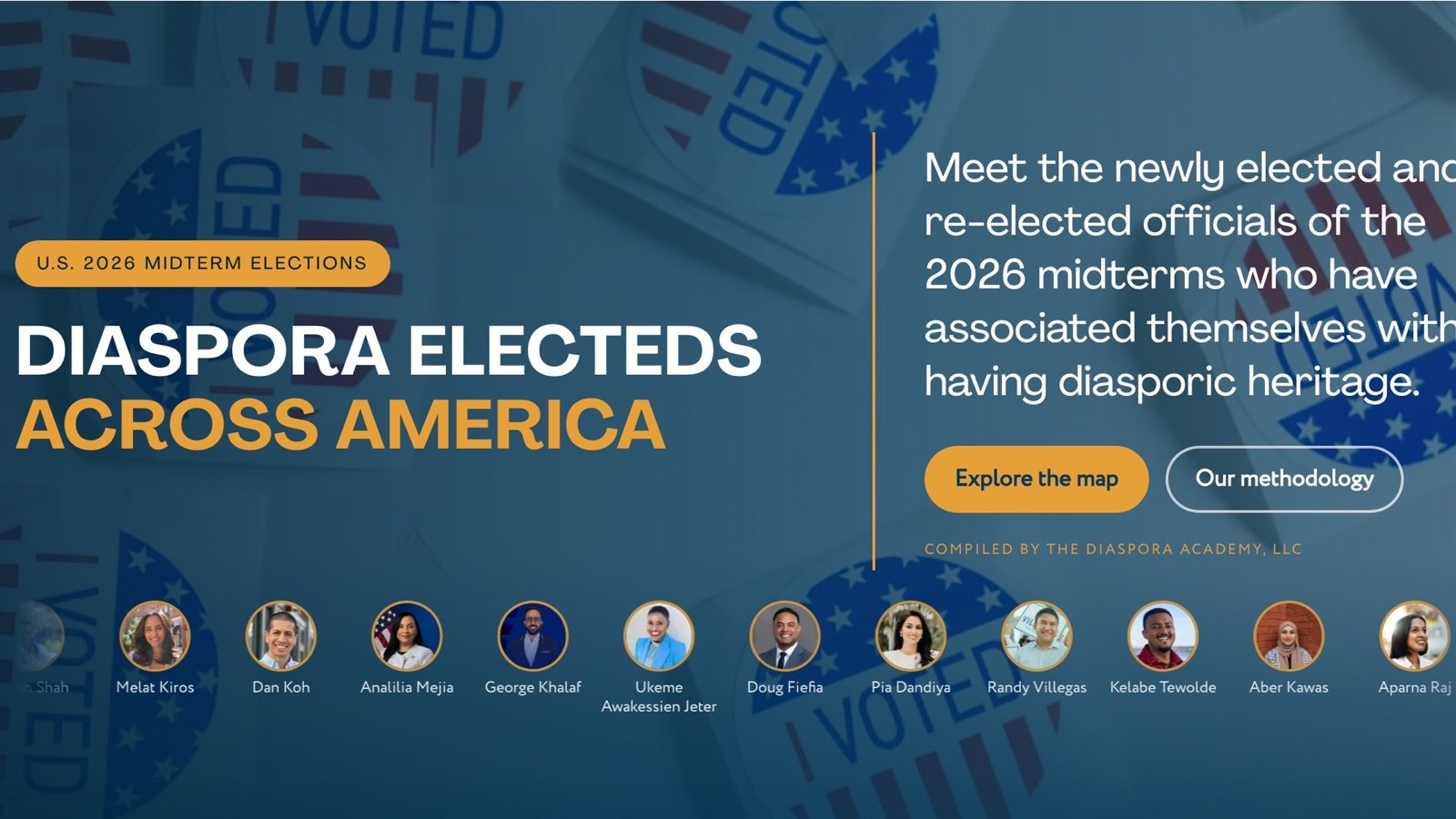
A shift has been underway in the United States for decades, and this year’s midterm elections showed us historic firsts and generational change at every level of government. This is why The Diaspora Academy is proud to announce the launching of the Diaspora Elected Officials Tracker, a resource and guide that follows these shifts as they unfold.
Not only has America elected multiple historic firsts, including electing:
- Keisha Lance Bottoms as Georgia’s and the nation’s first Black woman governor
- Scott Colom as Mississippi’s first Black U.S. senator since Reconstruction
- Peggy Flanagan of Minnesota, a citizen of the White Earth Nation, as the first Native American woman elected to the U.S. Senate
- Deb Haaland of New Mexico, a member of the Pueblo of Laguna, as the nation’s first Native woman governor
- Abdul El-Sayed, MD, DPhil of Michigan, a second-generation Egyptian-American, as the state’s first African diaspora, Afro-Arab, and Muslim senator, and the first Muslim elected to the U.S. Senate
It has also elected an incredible number of diaspora electeds who acknowledge and self-identify as being diasporic.
To date, TDA has counted:
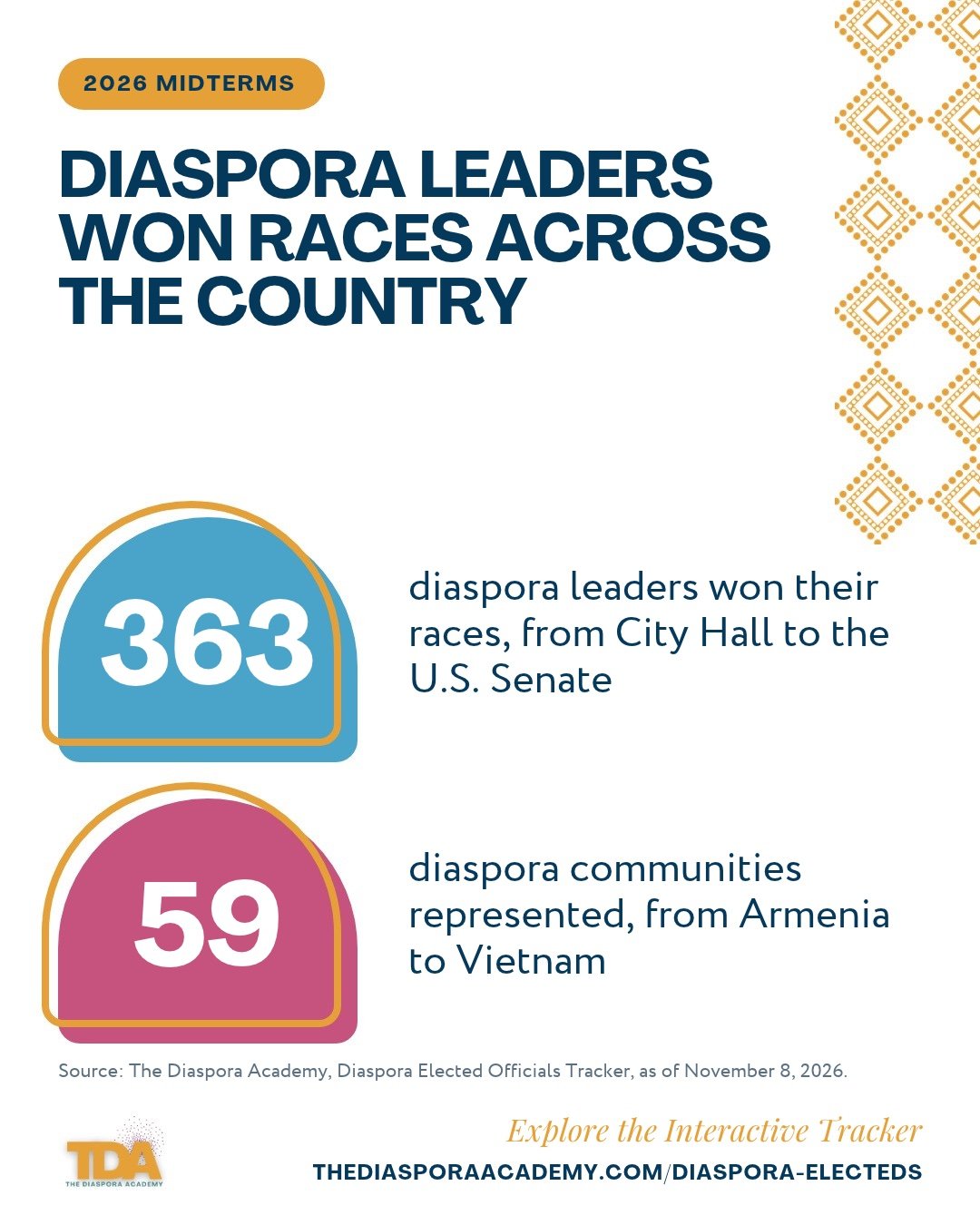
- 368 diaspora elected officials who speak openly about their roots
- Roots in 58 countries across every region of the world
- 113 leaders newly elected in 2026
- Service at every level of government, from town councils to the U.S. Senate
The new class of America’s leaders is rooted locally and connected globally
These midterm elections offer a window into the American constituency in all its beauty and representation.
Look closely at the leaders voters chose this month and a pattern appears. They are hyperlocal leaders, rooted in the cities, counties, and states that represent the American story. They grew up in the communities they now serve, they built businesses and classrooms there, and they know their neighbors by name. They also maintain deep ties to their ancestral homelands.
Some immigrated to the United States themselves. Some are the children of immigrants. Others descend from families who arrived generations ago and still honor their roots.
And much of this story unfolds far from Washington.
Our Tracker counts at least 228 diaspora officials in state legislatures, 51 in local office, and 20 in statewide office, alongside 68 in Congress. For instance:
- In Wisconsin, Yee Leng Xiong becomes one of the state’s first Hmong and Latino statewide elected officials, alongside Secretary of State-elect JoCasta Zamarripa.
- Xavier Becerra, a second-generation Mexican-American, becomes California’s first Latino governor elected by its voters.
- Will Jawando, a second-generation Nigerian-American, won the race for Montgomery County Executive in Maryland.
- Kelabe Tewolde, a Seattle educator and the son of an Eritrean immigrant, won a seat in the Washington State House.
- Meron T. Yohannes joins the Herndon Town Council in Virginia.
- Ruwa Romman, a Palestinian-American, heads to the Georgia State Senate.
In Congress, the range is equally wide:
- Africa. Melat Kiros immigrated from Ethiopia with her parents as an infant and becomes the first Gen Z woman elected to Congress and the first Ethiopian-American in Congress. Adrian Boafo joins Rhode Island’s Gabe Amo as one of two Ghanaian-Americans elected to Congress this year.
- The Arab world. Alongside Dr. El-Sayed, Adam Hamawy MD MBA FACS, an Egyptian-American surgeon born in Egypt, becomes the first Muslim American elected to Congress from New Jersey.
- Asia. Daniel Arrigg Koh, the descendant of Lebanese and Korean immigrants, becomes the first Asian American elected to represent Massachusetts in Congress. He has long named both sides of his family with pride: “My family came from two different parts of the world: Korea and Lebanon.”
- Europe. Chris Pappas, a fourth-generation Greek-American and the great-grandson of Greek immigrants, won New Hampshire’s Senate seat and celebrated at his family’s restaurant in Manchester, The Puritan.
Taken together, the members of Congress on our Tracker trace their roots to every region of the world.
Maintaining ties to a homeland is a story of honor and memory
The American story is not entirely diasporic. There are multiple experiences and histories reflecting Indigenous and Black memories where diaspora ties did not exist or were violently cut off. The reality of historic violence and genocide against Indigenous communities, and of enslaved Africans who were denied the right to know their history and remain connected to their ancestral homelands, is still the heaviest part of the country’s story.
It’s important to acknowledge that having diasporic ties is a level of proximity and access that not all Americans have or need.
But so much of America is about how people can choose to discover, develop, and maintain ties to an ancestral homeland. Memories and stories that honor the migrant tradition are built into our community stories, from the immigrant who opened a business or ran for office to the multigenerational descendant who shares their story and still honors where the family began.
Additionally, diaspora leadership, memory, and ties are a long American tradition. Time after time, we have witnessed American leaders honor their diasporic ties and bring that worldview into the partnerships and relationships they built. We hear it in the words of President Franklin Delano Roosevelt, President John F. Kennedy, President George H. W. Bush, Vice President Hubert H. Humphrey, and President Barack Obama.

Diaspora representation is woven into the American story. What makes 2026 historic is the breadth. We have never seen diaspora representation this plainly across every region of the world and every level of American government.
The Diaspora Elected Officials Tracker offers a full diaspora overview
That breadth is why we built the Diaspora Elected Officials Tracker. Institutions talk often about unlocking diaspora capital, and they rarely have the data to understand the demographic, the market, and the constituency behind it. The Diaspora Academy exists to unpack that for institutions, organizations, businesses, and communities.
As of this week, the Tracker follows 368 diaspora elected officials who speak openly about their roots, 113 of them newly elected. Here is what the data shows:
- They serve at every level. More than 290 of the officials on the Tracker serve outside Congress, including 228 in state legislatures, 51 in local office, and 20 in statewide office. Another 68 serve in the U.S. Congress.
- Their roots reach every region of the world. Officials with Asian roots make up 39 percent of the Tracker, Latin American and Caribbean roots 34 percent, African roots 15 percent, European roots 8 percent, and Arab and Middle Eastern roots 4 percent, with Pacific Islanders represented as well.
- Their ties take many forms. The Tracker includes 134 children of immigrants, 118 immigrants, and 25 officials whose ancestry reaches back further.
- Their homelands and home states tell a story. India, Mexico, Greece, and South Korea are the ancestral homelands named most often, and California, New York, and Maryland are home to the most diaspora officials.
Knowing diasporas as constituencies changes how institutions engage
In the United States, understanding diasporas as a demographic means understanding each community as a whole: how it came to this country, how it arrived and integrated, and the challenges and opportunities it faces here and in its ancestral homeland.
Understanding diasporas as a constituency goes further. It reveals their values, the issues that matter to them, where they stand on domestic and foreign policy, and how they contribute to public life and to their local communities. According to the Pew Research Center, about one in ten eligible voters in the United States is a naturalized citizen.
At TDA, we apply the R.O.P.E. framework to understand how diasporas drive impact: how they Represent, Organize, Participate, and Engage. In our Diasporas in America guide, which maps where diaspora communities live, lead, and build, we explore how and where diasporas behave as constituents, and how they organize locally and across the country.
The Diaspora Elected Officials Tracker takes the next step. It shows how these constituencies have produced leaders with an immigrant background, a diaspora tie, or an ancestral memory that is part of their American experience.
We know diasporas move capital, unlock resources, and mobilize communities. The harder question for institutions is this: do you know who they are, how they behave, and what they engage in?
Can you root that understanding in an American story and an ancestral homeland story at once?
These midterm elections show what becomes possible when you can.
What institutions can do with these insights
- Map the diaspora leaders whose offices reach your work. City, county, state, and federal officials with diaspora roots understand communities, markets, and partnerships across borders, and the Tracker shows where they serve.
- Engage with diasporas as stakeholders before designing programs. Begin with the values, issues, and civic life of each community, then build partnerships around what you learn.
- Treat civic leadership as part of diaspora capital. The vote, public service, and community organizing belong in your engagement strategy alongside giving, investment, and talent.
America’s story keeps widening, and its diasporas keep writing it. Here is how to go deeper:
✅ Explore the Diaspora Elected Officials Tracker to see the diaspora leaders who serve your city, state, and region.
✅ Get the Diaspora Elected Officials guide for sourced profiles of each official, plus a Diaspora Engagement Checklist for your next meeting.
✅ Get Diasporas in America: An Institutional Guide to see where diaspora communities live, lead, and build community across the United States.
Join the Diaspora Digest for weekly diaspora insights.
